About Open Science
Open science refers to scientific practices aimed at making scientific knowledge and data as widely accessible as possible, and ensuring that research processes are open and transparent not only to the scientific community but also to society at large.
In UNESCO’s Recommendation on Open Science, adopted on November 23, 2021, the concept of open science includes the following areas: open scientific knowledge, open science infrastructures, scientific communication, open engagement of societal actors, and open dialogue with other knowledge systems.
Key Principles of Open Science According to the UNESCO Recommendation:
The principles of open science apply to all scientific fields and research practices.
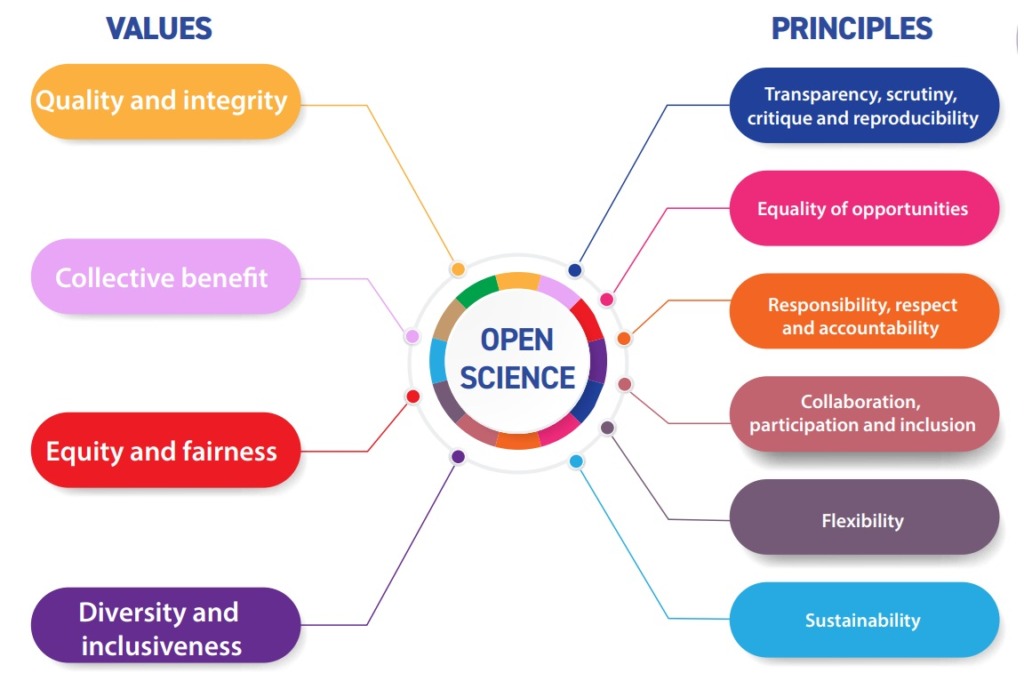
Picture from UNESCO Recommendation on Open Science
More about open science:
Open access courses and learning materials about open science:
Policies
Open Science Policies
Open science policy defines the strategy and action plan aimed at implementing the principles and practices of open science. Regulations of open science are usually prepared and approved by institutions conducting or funding scientific research, governments, or publishers.
UNESCO Recommendation on Open Science (2021)
UNESCO is an international organization that encourages member states to develop national open science strategies based on common principles. In 2021, UNESCO adopted the Recommendation on Open Science. The document has been translated into eight languages, including Lithuanian.
This is an official document that defines the concept of open science, describes its values, principles and objectives, provides implementation guidelines for member states, and highlights the importance of international cooperation.
Open Science Policy in Europe
The European Commission (EC) is the main institution shaping and implementing open science policy in the European Union. The EC develops the European Open Science Cloud (EOSC), supports the publication of research outputs in open access through the Open Research Europe (ORE) platform, and integrates open science principles into the Horizon Europe program.
Open Science Policy in Lithuania
On August 30, 2024, the Research Council of Lithuania (in Lithuanian, Lietuvos mokslo taryba, LMT) approved the Regulations on Open Access to the Results of Scientific Research and Experimental Development (in Lithuanian only), which replace the Guidelines for Open Access to Scientific Publications and Data approved in 2016.
The guidelines of 2016 remain in effect for calls announced before January 1, 2025, and will expire on December 31, 2028.
The new regulations emphasize the importance of open access in ensuring the accessibility, transparency, and quality of R&D results, promoting the open science movement, increasing the international visibility of Lithuanian science, and ensuring greater social and economic impact.
Some provisions of the Regulations will take effect on January 1, 2030 (Sections 14, 16, and 19).
From January 1, 2026, Sections 8, 9, and 31 will take effect:
8. A research publication must be deposited in a trusted repository after publication and, if no embargo period is specified, it must be made openly accessible immediately. Unpublished scientific works submitted to a preprint repository must be made openly accessible immediately. The deposited research publication or preprint must include a reference to the funding institution or the funding institution and the project.
9. The metadata of a research publication or preprint in the repository must be fully open, searchable, and machine-readable, even when the publication is under an embargo.
31. Research and higher education institutions must, in accordance with the provisions of the Regulations, establish procedures for managing the publication and opening of R&D results.
The decision to postpone the entry into force of certain provisions was made to ensure a smooth transition period and allow the scientific community time to prepare for the implementation of open access principles.
The Regulations apply to all calls for proposals administered by Research Council of Lithuania after January 1, 2025.
Open Science Policy at Kaunas University of Technology
On April 2, 2025, Kaunas University of Technology approved updated KTU Regulations on Open Access to Scientific Publications and Research Data. These regulations replace the 2016 version, which had been based on Research Council‘s of Lithuania open access guidelines.
Together with the updated KTU regulations, a KTU Data Management Plan Structure and Recommendations for Preparing a Data Management Plan were developed.
For consultations and information regarding the implementation of open access provisions at Kaunas University of Technology, please contact the KTU Library.
Contact person: Ieva Cesevičiūtė, email: ieva.ceseviciute@ktu.lt, phone: +370 (37) 300 284.
European Open Science Cloud
Supporting the EU’s Policy of Open Science, the European Open Science Cloud (EOSC) aims to give the EU a global lead in research data management and ensure that European scientists enjoy the full benefits of data-driven science.
The EOSC aims to provide researchers and innovators in Europe with an open, trusted, and multi-disciplinary environment where they can publish, discover, and reuse research data, tools, and services. By aligning and scaling resources across Europe, EOSC seeks to accelerate open science, boost research productivity, and enhance reproducibility and trust in scientific results. It supports interoperability across disciplines and promotes the reuse of data in line with the FAIR principles (Findability, Accessibility, Interoperability, Reusability).
The EOSC EU Node, procured by the European Commission, was launched in October 2024. It is the first node of the EOSC Federation, providing a set of data, tools and services to researchers across Europe. More information about EOSC EU Node services is available on the European Open Science Cloud EU Node website.
Plan S
On 8 September 2018, a group of national research funding bodies, supported by the European Commission and the European Research Council (ERC), announced the launch of the Coalition S (cOAlition S), an initiative to ensure the immediate implementation of open access to scientific publications. This initiative is designed to implement Plan S, which consists of 10 principles.
Coalition S will implement an action plan to achieve this goal:
“From 2021, all scientific publications funded by national, regional or international research councils and funding bodies must be published in open access journals, open access platforms or made immediately available on open access repositories, without an embargo period”.
The founders of the S Coalition (a group of national research funding bodies and charitable foundations) decided to jointly implement the 10 principles of Plan S with the European Commission and the European Research Council. Public and private research funders from all over the world are invited to join Coalition S. Representatives of research funders who would like to join the initiative can apply here.
For more information on Plan S.
Open access to scientific publications
Lithuanian Academic Electronic Library (eLABa) is a national repository of the Ministry of Education, Science and Sport and an open access repository of the Lithuanian academic institutions. 50 institutions are members of eLABa consortium (universities, institutes and research centres).
Green Open Access Road (self-archiving)
The published work or the final peer-reviewed manuscript that has been accepted for publication is made freely and openly accessible by the author, or a representative, in an online repository. Some publishers request for Open Access to be granted only after an embargo period has expired. The embargo period can vary between several months and several years. Usually, for the publications that have been deposited in a repository but are under embargo, at least the metadata are openly accessible.
Gold Open Access Road (Open Access publishing)
Gold Open Access (Open Access publishing): the published work is made available in Open Access mode by the publisher immediately upon publication. The most common business model is based on one-off payments by authors (commonly called APCs – article processing charges – or BPCs – book processing charges). Where Open Access content is combined with the content that requires subscription or purchase, in particular, in the context of journals, conference proceedings and edited volumes, this is called a hybrid Open Access.
In the Registry of Open Access Repositories – researchers can find 4725 (data of 11 November 2019) registered institutional and thematic repositories where research publications can be uploaded. The institutional repositories are often administered by the research institutions in order to preserve and share the research results. The thematic repositories are usually administered by the research community; these repositories preserve the subject-specific research publications. The publication repositories are an alternative way to have access to the research publications when access to the primary resource is unavailable.
Over the last few years, the number of open access journals has rapidly increased, researchers have greater freedom of choice where to publish the research results. Currently, there are more than 13 900 research journals and 75 Lithuanian journals registered in the registry of open access journals Directory of Open Access Journals (DOAJ) (data of 11 November 2019). The open access journals not only ensure open access and licencing but also provide the necessary conditions for reusability. The majority of journals registered in DOAJ registry do not charge any article processing charges; more information about research is available here.
Directory of Open Access Books is a registry of open access books providing access to more than 22 000 books (data of 13 November 2019).
Citizen science
Citizen science allows people who are not professional scientists to participate in a wide range of scientific activities, from collecting and analysing the data for a research, to disseminating the results of the research or even formulating the research problem. Citizen science brings opportunities for collaborative learning, for building a scientifically literate society, for creating innovations that respond to community needs, for sharing resources and for sustainable problem solving.
For more information on citizen science, click here.
Seminars, conferences in Lithuania
Recordings of the webinar „Horizon Europe Open Science requirements in practice“
The OpenAIRE webinar “Horizon Europe Open Science requirements in practice”, held on 14 March 2025, addressed relevant aspects of research project compliance with Horizon Europe. During the workshop. The speakers presented the Open Science and Open Access requirements for scientific publications and research data for projects under the European Horizon (HE) Programme. Also the European Commission’s Open Access publishing platform “Open Research Europe”, and other useful tools for researchers from OpenAIRE, such as the EOSC EU Node platform, the anonymisation tool AMNESIA, and the ARGOS platform for data management plans were presented for the atendees.
Recording of the webinar: https://youtu.be/dN0ehvmUs9c.
Slides of the presentations: https://doi.org/10.5281/zenodo.7324363
KTU Library organised a webinar “Unlocking Knowledge: Perspectives on Open Science”
On 21 October, the KTU Library organised a webinar “Unlocking Knowledge: Perspectives on Open Science” to celebrate Open Access Week. Three guest speakers gave presentations on the topics of increasing the visibility of scientific knowledge and research data management for early career researchers. The event was held in English.
Presentations:
“Focus on Open Science” event for researchers, research administrators, representatives of academic libraries
On the 29th of October, 2019 in Kaunas University of Technology “Santaka” valley event for researchers, research administrators, representatives of academic libraries took place. In the event were discussed issues related to the European Open Science Cloud (EOSC), research data management skills, research evaluation and other changes in scholarly communication.
The event is part of the series “Focus on Open Science”.
Practising FAIR and Open Data Management
On the 19-20th of April, 2018 PhD students and researchers participated in practical seminar on open research data management Practising FAIR and Open Data Management”, seminar was held by data management experts Elly Dijk and dr Marjan Grootveld from „Data Archiving and Networked Services“ (DANS) organization (Netherland). Seminar was organized as one of OpenAIRE2020 project activities.
International conference “Academic Library and Open Science”
On the 6th of December, 2016 international conference “Academic Library and Open Science” was organized. Video recording and slides:
FOSTER seminars
On the 29th of October, 2019 a seminar “Open Access to Research Data” was organized. Video recording and slides are available.
On the 31st of March, 2016 a seminar „Open Access to Research Data“ was organized. Slides:
Open Science Lt
This is the Open Science Lt website, developed by the library staff, where you can find relevant information and news.